Join the community

This week my publisher begins our weekly author support group call.  I will detail this, because I think it’s an innovative way to build a community from people who will likely never meet in person.  If it works, maybe someone else can use the idea to their own benefit.

However…

I have to move my websites to a different (better?) server.  It’s called ‘reprovisioning’ in IT double-speak, but what it really means is ‘pain in my ass.’  This particular site promises to be very, very easy, since Automattic has offered to do most of the work for me.  But we’ll see.  I’ve been working in IT for a very long time, and nothing is ever as easy as it seems.  This week, for instance, has been ‘Get Don To Do Stuff He Hasn’t Done In 15 Years’ Week.

I’m asking you to please, bear with me.  This site may be up and down the next few days, as this moving mess works itself out.  My post about tomorrow’s meeting may be this weekend, for all I know.  Things will smooth out eventually.  I hope.

In the meantime I’ll brush up on my old MS-DOS commands, because the way things are going I’ll probably need them.

Join the community

Join the community

My publisher has formed an authors’ support group. They asked me to be part of it. I agreed. It’s very strange.

Let me explain: I’m not a joiner. I do my own thing, hoe my own row, tread my own path, etc. etc. I’m very used to doing things on my own and by myself. The idea that I would get together with anyone – let alone other writers – to… I don’t know… share? doesn’t sit well with me. It’s a little touchy-feely to be honest. It makes me uncomfortable even to think about, let alone do.

So I’m leaning in. I’m old enough now that I know myself pretty well, and if I’m shying away from something like this I need to shove my misgivings aside and jump in the deep end. Its for my own good.

We had our first meeting yesterday, a technical review of how the platform works and etiquette while logged in. There were writers from all over in attendance, of varying degrees of technical competence, and of varying degrees of commercial success. Lots of laptops, so I’m kind of the odd man out there, but I prefer a straight spine at a desk rather than a slumped spine on a couch. Plus, when I’m beaming an image from a desk people don’t have to look up my nose.

This group is only for clients of this particular publisher, so I can’t invite anyone else on my journey, but I’ll let you know how it goes. The idea, as far as I know now, is help with marketing and getting the word out, but also general help and support. I have no idea what that means, as I mentioned, I’m trying to get over being the lone wolf.

There’s the concept of liminality in life, acting, writing. It’s the idea that you can get stuck on the threshold (limen in Latin, for my old students) between one thing and another. This job or a better one, that romantic partner or a different one, success and failure, moving forward and status quo. You can’t stand in the doorway forever, you either have to step through, or step back. Despite my every instinct to the contrary, I’m stepping through.

It’s still weird, though.

Join the community

Join the community

Publishing News: they’ll start on the Developmental Edits before too long. Probably next week. There’ll be back-and-forth with me for over a month on this part. I’ll let you know what’s happening and how it’s going as soon as I have news.

I recently got involved with the #writerscommunity on Twitter. I recommend it, even if you never post anything or respond or even make yourself known other than following other writers. It’s tough out there on your own, and most writers are absolutely on their own. Friends and family might be supportive (or not), but that only goes so far. You need to interact with people going through the same things you are, and modern social media certainly helps. A lot. If you’re not already part of it, get on Twitter and find the threads. You are not alone.

I noticed a definite trend in the #writerscommunity postings, of writers who are ‘stuck.’ That is, they’ve come to a certain point in their work and they can’t see a way forward. A variation on that is writers who reach a certain point in their work and realize they’ve been going down the wrong path and have to regroup and start over. I’ve been there, and I know exactly why this happens. Some of you are going to agree immediately, and some aren’t going to like this next sentence at all.

You don’t know what your story is.

I’ll try to soften this by saying again, I’ve been there. I’ve done this. You have a really great hook, or a really great setting, or a really great main character, or a really great theme. With this really great thing in mind you dive into the deep end and start writing. The problem is, you haven’t done the very basic work you need to do in order to write a book: Understand thoroughly the story you’re trying to tell.

‘I’m not a plotter,’ you protest, ‘and I don’t work the way you do. I let my story sing through my fingers on the keyboard. Don’t shackle me with your notecards and plot points and character arc notes. I do things my way.’ Fair enough, but I’m not talking about how you do your work, I’m talking about the story you want to tell.

At its most basic, a story has a beginning, a middle, and an end. When a writer gets stuck, it’s because they’re missing one (or all) of these parts. This is the ‘and then…’ excitement you get when you tell a story to child. This happens, then this happens, then another thing happens, and then… and then.. and then…

If you don’t have an ‘and then…’ all the way to the end, you don’t have a story.

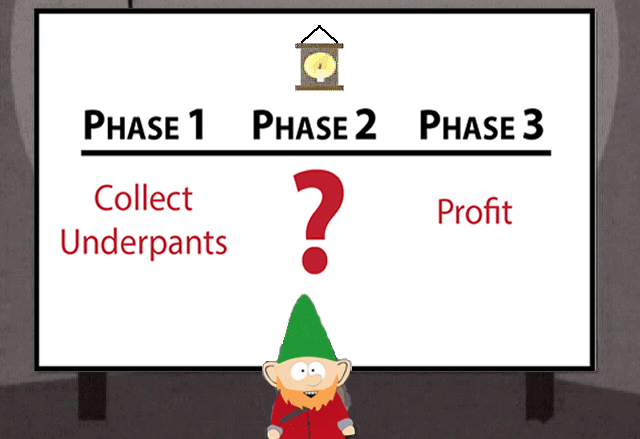
Twenty years ago (yikes!) South Park had an episode that was an indictment of the booming pre-Y2K tech bubble in the stock market. The allegory was gnomes who were stealing underpants with the aim to make a profit. The only problem was the gnomes had no idea how to connect stealing underpants with making money. They had a beginning and an anticipated end, but no middle at all.
underpants-gnomes-business-plan.png

This exact thing is happening with writers who don’t know what story they’re trying to tell. They’re trying to connect the thing that excites them – their hook, character, setting, or theme – with a finished book. They don’t understand the middle part, the actual story, at all, and that’s why they’re getting stuck, or having to rework it, or abandoning it altogether.

So what’s the fix? What do you do when this happens? You’ll have to find what works for you, but when I’m working on a story, I talk it out. I tell the story, just like Homer did 2,800 years ago, out loud, over and over and over. It helps that I live alone. Talking out the story, telling the story, helps me get a handle on it, to understand what I want to say and how I want to say it. Pretty quickly I also get to know what I’m missing. Once I know the story then I can get to the technical parts and start constructing the narrative.

Maybe next week I’ll have details about the developmental editing process? We’ll find out together.

Join the community

Join the community

Last time I described some of the tools I use when I’m outlining. I also included a list of ‘The W’s’ I got from my acting teacher many moons ago. For reference this week, I included them again:

WHAT has just happened? The Moment Before. The Characters’ emotional states.
WHAT is happening? The Apparent Event. Actions/Behavior
WHAT do you want? The Objective or Actual Event. Emotional need.
WHERE are you? The Environment. Create a setting.
WHO are you? The Characters and Relationships.
WHAT is the obstacle? The Conflict.

I came to this list as an actor, and it’s invaluable for breaking down a scene into bits an actor can use to create a believable performance. It’s also really great for a writer to get a handle on each character in a scene. In order to illustrate this point, I’ll break down one of the first scenes in Special Circumstances. From the first chapter, it’s where one of the main characters, Travis Lynch, goes to witness the execution of a man he tried to save from death row ten years earlier. While in the viewing room, he meets Christine Morton, the reporter who almost ruined his life, also ten years before.

For Travis:
The Moment BeforeTravis spent four hours driving through Texas in a car with no air conditioning in August to get to Huntsville, where the executions take place. On the way he was recognized from his disgrace ten years ago.
The Apparent EventTravis agreed to be a witness to the execution of Reilly Wayne Sutton, and act as a proxy for Sutton’s family, who will not attend.
The Actual EventTravis comes face to face with the reason for his estrangement from his brother, and with the instrument of his public disgrace, Christine Morton.
The Environmentthe viewing room on death row, where people watch the condemned die.
The Character and RelationshipsTravis has become the black sheep of his family because of his conscience and morality. He hates Morton because of the way she used his crisis ten years ago to make her career.
The ConflictTravis doesn’t want to be there, and is unprepared for the shock of watching another human being die. He also loathes Morton but needs her experience with this situation to hold it together until the end.

For Morton:
The Moment Beforeshe saw Travis Lynch walk into the one place she never thought she’d see him, the viewing room on death row. She considered leaving him alone, but her reporter’s instinct would not let her do that.
The Apparent Eventshe’s doing what she’s done many times before, being the media witness to a Texas execution.
The Actual Eventshe realizes Travis is in way over his head, and she helps him through the experience even though she knows he hates her.
The Environmentthe viewing room on death row, where people watch the condemned die.
The Character and RelationshipsMorton has the strength of her convictions behind her, and her ethic as a member of the Fourth Estate. She knows she rubs many people the wrong way, but she views her job as a public trust. She also wants to completely understand events from ten years ago, and Travis is the only one who can provide her closure on the remaining gaps. She needs to talk to him, but he’s clearly unwilling.
The ConflictTravis needs her help, though he doesn’t understand that at first and resists even looking at her. She wants to use this opportunity to cultivate Travis as a source. She also thinks she’s immune to the emotions of watching an execution, but she really isn’t.

That seems like a lot, doesn’t it? But it’s the skeleton on which I can hang the meat of the scene. This provides me relationship, tone, backstory, and conflict. I know where the scene begins and where it (sadly) ends. I know the middle part. I know how the characters are changed as a result of the scene, which then is ‘Moment Before’ for their next scenes.

These two are major characters in this story. You don’t need to go into quite so much detail with other characters. For instance, the condemned, Reilly Wayne Sutton, appears in this scene. It wasn’t necessary to define him with The W’s, because his role here is to provide emotional energy and some exposition, and then, ultimately, to die. One and done, as it were.

I hope you find this method as useful as I do. It takes guesswork and uncertainty out of things for me, and lets me focus on making the characters and their interactions as real as possible.
Join the community

Join the community

Still no assignment from my publisher – it’s probably going to be after the New Year, I’m guessing – so I’m going to show you how I work. I promise, as soon as I get deeper into the publishing process you’ll be the first to know.

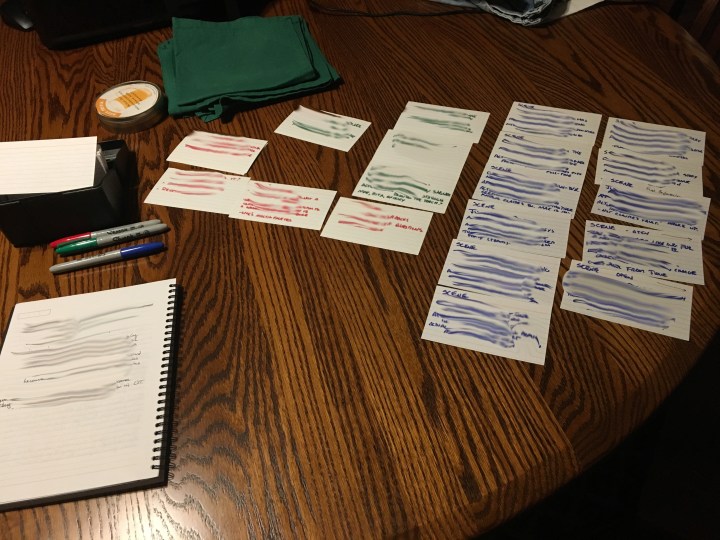
For the next part, reference the photo below. This is my kitchen table, one of the places I work. I go here when I need a solid surface, like when I’m doing my note cards. Note: do not attempt to adjust the picture, I’ve blurred the words on the note cards and my pad because I ‘m working on a sequel to the novel being published next year (spoilers, sweetie).  I’m not very far along, there are going to be a lot more of each type of card.

work_blurred

I use note cards in my plotting. Over the years I’ve found it’s easier to move things about, add, remove, and enhance. There is a method to this:

  • Red cards are definite actions, emotions, or events that drive the plot. These need to be in the story explicitly. For instance, the crime that sparks the plot, including all the details the reader discovers over the course of the story.
  • Green cards are character elements that are softer than the red cards. A character’s initial outlook, for example, or the change that the story provokes in them. These are not explicit in the story, but emerge out of it. The ‘show’ in ‘show, don’t tell.’
  • Blue cards are scene cards. The basic building block of a novel is the scene, at least the way I do it. There’s not enough room on a card to go into all the detail I need in a scene, these are really just detailed place holders. I can also tack these onto the cork board in my office so I can follow the flow of the narration. (see below for more on scenes)

The spiral note pad in the bottom left is a small pad I carry with me most places, where I write down whatever I’m thinking about the story. I do tend to repeat myself over time, so I re-read my notes probably once a week. The things that look like red, green, and blue Sharpie markers are exactly that. The black box is a note card holder. The round thing is a container of beer-themed coasters. The green things are cheap cloth place mats.

The Scene
A long time ago, in a foreign land (Los Angeles), I used to be a working actor. I didn’t get rich doing it, but I did buy a fancy convertible with the money I earned acting, so I’m ahead of 90% of working actors. I started acting because, in order to make my writing better, I wanted to know what actors did. I discovered I was a pretty decent actor, so I stuck with it, got an agent, landed some gigs, made some money. Much more important, though, was the scene breakdown I learned as an actor. It works so well I started using those elements in my writing, which got much tighter, and more emotional. It’s not a secret, so here’s how I break a scene down. From my acting teacher June Chandler*, who I’m sure got it from her teachers at her school, it’s called ‘The W’s.’ She even gave us a little business card with the W’s on it, which I still have and still refer to all the time.

WHAT has just happened? The MOMENT BEFORE. The Character’s emotional state.
WHAT is happening? The Apparent EVENT. Actions/Behavior
WHAT do you want? The OBJECTIVE or Actual Event. Emotional need.
WHERE are you? The ENVIRONMENT. Create a setting.
WHO are you? The CHARACTER and Relationships.
WHAT is the obstacle? The CONFLICT.

I’m sure any number of writing books give a similar breakdown or approach, but this one is specific to an actor navigating a scene as an individual. It’s a rubric for how an actor should break a scene down to digest it and turn those details into a performance. But, as it turns out, it’s also a very handy method for a writer to flesh out a scene, you just have to define the W’s for all characters in the scene.

Next time I’ll go through how I use The W’s to build up a scene in a novel.

* June’s amazing, and I love her a lot.  I’d take a bullet for her, and that’s not a metaphor.

Join the community

Join the community

In a previous post I wrote about how I manage my ideas. TL;DR – Notice Stuff, Write It Down, Read It Again.

This is fine, it’s a method for not relying on your flawed memory. But a story is much more than a laundry list of stuff you noticed during the day (unless you’re talking about a Seinfeld episode, then it really is just a laundry list). You need characters and plot points and emotion and conflict and resolution and all that stuff. No matter how cool, accomplished, and savvy you are, you’re only just one person. Despite your best efforts, you can’t know, do, or be everything. Your personal scope is very limited.

So how do you expand your scope? Travel is a great way. International travel. To a place where you don’t speak the language and can’t read a newspaper. I used to work for a government contractor, and I traveled all over the world. I can tell you for certain that my perspective expanded immensely in those three years. I was not the same person on my last day as I was on my first, and I came out the better for it.

But what if you don’t have the good fortune of being paid to travel on the Federal government’s dime? What if you can no more afford a trip abroad than you could pay off your mountain of student debt? What if the court says you can’t leave the county? What if you’re agoraphobic? You can read non-fiction, but even better, you can watch non-fiction. You can find slice-of-life videos everywhere online. Search them out, people are eager to show others how they live, and visitors are eager to show differences, too. Google ‘Japanese toilets’ for a good start on how different other cultures can be.

Absent travel, what’s a fantastic way of expanding your scope? Exploiting your friends and family. You go to work every day, and you do stuff and know stuff that’s a combination unique to you. Nobody else does your job quite like you do, nobody else has the exact same interests and hobbies you do. The same is true for every other person on the planet, including your boring family and idiot friends. Everybody you meet knows something you don’t. So ask them about it.

For instance, I have an attorney friend (mentioned previously) I can bounce stupid legal notions off of. I am always wrong, and Attorney Don gently corrects me, but his regular work day is labyrinth of interpretation and ambiguity that I just can’t wrap my head around. Talking to him lets me appreciate how a good attorney is like a good chess player, always thinking one move ahead.

I have a friend who spent years as a lab tech, and just this week I had lunch with her to pick her brain about what happens to a person who dies of liver failure. This is for the sequel to Special Circumstances that I’m writing now. She’s forgotten more about that kind of thing than I’ll ever know, and she helped me pin down a terrible, terrible death for a terrible, terrible character. It’s what friends do.

Talk to strangers. I know, I know, it’s a scary world out there, and you have to pick and choose who you let into your circle of trust, but I have learned so much talking to complete strangers. Like why you don’t want to weld in the rain but sometimes you have to do it anyway. Like how slowly the plane I was a passenger on would have to fly to drop out of the sky. Like how many different diagnoses it would probably take to get on full disability. Like how complicated the chemistry of toilet paper actually is. Like how emergency rooms have printed protocol on how to get stuff out of people’s butts because getting objects stuck in their butts is a thing people regularly do.

I encourage your curiosity. Find out what makes people tick. Find out what makes YOU tick, your writing can only benefit.

Join the community

Join the community

It’s Thanksgiving week, and I didn’t expect to get anything from my publisher, they’re as distracted as everyone else. Possibly even not in the office. So I’m at loose ends again. Every so often people will ask where I get my ideas for characters or plots, or how I manage the ideas I do have. That’s the topic of this post, how I manage my own creativity.

SOAP BOX: I’ve read other advice from ‘creatives’ about how to be creative, and, honestly, those things mostly leave me flat. They assume that a ‘creative’ is someone special instead of someone lucky, and that they have a talent for creating that no one else has. Let me tell you, a single mother trying to feed her family on minimum wage can get very creative with a budget. A programmer trying to make an interface match the design specs can get very creative. A plumber trying to solve toilet issues in a a 50-year-old house can get very creative. All human beings are innately creative, that’s part of being alive. Those of us who get paid to write, draw, or act need to get over ourselves, we’re just lucky.

Now, off my soap box, I’ll share with you how I’ve learned to deal with ideas and inspiration. I’m a little uncomfortable with this, I don’t want to be like the ‘creatives’ I’ve read before, but maybe this is something other people will find useful for their own process.

  • I notice stuff. You can ask anyone I’m around, I pay attention to things others won’t, especially people. The way someone walks. The rings on their fingers. How they look at the person they’re with. Conversations between friends or strangers on the bus. It’s all relevant to me, it’s all interesting to me. I’m very conscious of my own background, privileges, and shortcomings, so paying attention to other people lets me try to put myself in their shoes, to see life from their perspective. I also try to keep in mind something my father once told me when I was being particularly insufferable: ‘everyone you meet knows something you don’t.’
  • I write down the stuff I notice. Yes, every time. Back in the olden days I had to carry around a little notebook and a pencil (pens run out of ink, you can always sharpen a pencil). Now I have a smart phone with a built-in notepad that synchs to ‘the cloud,’ and a magic genie named Siri who only listens to me when I call her name. When I get home where I have paper and a pen, I transcribe my notes from my phone.
  • I read my notes again. It’s great if you write down your observations, but if you never come back to them you’ve just wasted a lot of effort. Once a month or so I’ll drag out an old notebook and page through it. I have tons of notebooks, so I rarely repeat myself during a year. I always find something fascinating that I’ve forgotten.

Notice stuff. Write it down. Read it again.

“This is great for educating yourself on the human condition,” you might say, “but what about the meat and potatoes of writing? What about characters and plot?”

Character For me, characters start with someone I know. A character has certain traits, and I associate that character with a person I know who has similar traits. Yes, sometimes I base a character on an actual person, but more often the character has some archetypal traits that more or less match someone I know. Doing this helps me get a handle on who the character is, and I can build from there. No, I will not tell you who I’ve based my characters on; if you know the people I do, you could probably figure it out.

Plot Plots are stories, so when I’m developing my plots I pay attention to real-life stories. I watch the news, read the paper (online sometimes), and read non-fiction. You can’t make up anything more twisted and convoluted than actual events. Real life stories involve the basest, ugliest emotions and the most noble human aspirations, and everything in between. Once you understand – or try to understand – what motivates real people, you can try to gin up a plot that motivates your fake people.

There’s more to it than just these things, of course, and I’ll get into more detail in later posts.

Join the community

Join the community

Since I have no assignment from my publisher yet, I thought I’d share my process. I’m currently planning the sequel to my novel that will be published next year, neck-deep in details and ideas and beats. I know everyone’s process is different, but perhaps learning mine will help someone else.

My Step 1 : Decide what the story is.
This sounds deceptively simple, but it really is straightforward. I’ve talked to writers who launch into a ten-minute dialogue about their book, and at the end, as they catch their breath, I know a lot of detail around the story, but I don’t really know what the story is. For my money, these people have wasted a lot of their time on window dressing without making sure the foundation of their house is solid.

You may see other advice about building the story out of elements that come up as you’re writing, but I think that approach is bankrupt. If you don’t know the story you want to tell, starting to write is just an exercise in futility and frustration as eventually, when you discover what your story actually is, you’ll have to discard much of the work you’ve already put in. Work smarter, not harder, as my grandfather often said.

Here are some examples of stories. Each of these examples presents a simple enough story, but the outcomes of those simple stories make masterpieces of literature.

  • The Iliad – this is the story of a few weeks during the Trojan war when the commander Agamemnon and his best soldier Achilles have a falling out over a girl taken as a war prize.
  • Hamlet – this is the story of how a Danish prince exposes his father’s murderer but also brings ruin onto his entire family as a result.
  • The Great Gatsby – this is the story of how a self-made millionaire uses his fortune to win back his old lover who has married into old money and respectability.

My novel is the story of two brothers, attorneys, estranged for 10 years over a death penalty case, who try to settle the score over a different death penalty case.

My Step 2 : Start taking notes.
This part of my process is essentially brainstorming. Kind of. Maybe brainstorming with a little critical thinking thrown in.

During real brainstorming you just throw out idea after idea after idea, with no censorship or editing. There are no bad ideas. It’s only after brainstorming is over that you can go back and critically evaluate what you’ve come up with.

When I take notes, it’s not really brainstorming, because I already know what my story’s about. I’m past the ‘no bad ideas’ phase. I do censor myself, and I can have stupid ideas (often), but I try to keep the ideas flowing. What I’m trying to do with my notes is discover the individual stories inside the larger stories. In writer jargon, I’m trying to find the themes (overall subjects or motifs) and the beats (plot points).

These notes take several forms, I usually start with a notepad where I write down what I’m thinking about the story. I keep this pad with me most of the time, but in a pinch I’ll use the notepad on my phone and then transfer to paper. I prefer to keep these notes handwritten, because writing forces me to slow down, which lets my idea settle into my brain. I find when I type things out they stay in my brain as long as it took me to type them, only a few seconds.

After a while – half a notepad or so – I’ll have enough to start making note cards. These are regular 3 x 5 cards, and, yes, I do use the analog ones, the kind you hold in your hand. Again, typing is not my friend here. I need my own handwriting. I need the cards, so I can arrange them and rearrange them, and discard them, and recover them. I’ll tack them to my cork board, I’ll spread them on the table or on the floor. The cards are as much a tool to me as a chisel is to a carpenter.

Step 3 : Turn the notes into an outline.
When I have what I think is a decent story – or a decent start, anyway – I’ll create an outline. This outline is not your standard I.A.1.a sort of outline. I’m not making assembly instructions. Rather, this outline is more of a mind map, Plot point is connected to character is connected to theme is connected to story arc, and so on.

Before I start an outline I always know where the story starts and where it ends. I usually know major parts of the middle. Most of the rest of the story – the meat and potatoes – comes up when I create the outline. With an outline I can see where the story is thin, or where I’m jammed up with too much junk, or where there’s a gaping hole when I thought I’d built a wall.

The most important concept here is that my outline is a living document. It’s not a rigid blueprint, it’s a web of relationships that the story emerges from. My outline changes over time.

I’ll leave off here, I’ll revisit this topic the next time I don’t have anything to do for my publisher.

Join the community
Join the community

My publisher hasn’t requested I do anything this past week, so I thought I’d share some of the books that I enjoy, that formed the author I am right now.

A Single Man by Christopher Isherwood. If you’d asked me before 2013 what my favorite book was, I would have had a different answer. Hemingway said ‘All you have to do is write one true sentence. Write the truest sentence that you know.’ This book if full of true sentences. It’s the story of an Englishman who lives in Southern California and works at a university in downtown Los Angeles. Christopher Isherwood was an English expat who lived in Santa Monica and worked at USC. True sentences.
While I love this book, the literary world seems divided. One of my friends, also a writer, read this book and absolutely hated the whole thing. Give it a try, I hope you’ll like it.  Fiction, but really a fictionalized account of the author’s life.

Detroit by Charlie LeDuff. This is the story of Mr. LeDuff’s two years at the Detroit News, and what he learned about the corruption and incompetence in the city that’s become the example for everything that’s gone wrong in America. It’s also a story of self-discovery for Mr. LeDuff and a lesson in ‘no matter how bad you think it is, the truth can be much, much worse.’ Non-fiction.

Dune by Frank Herbert. This is the space opera saga that David Lynch made into a pretty terrible movie, and that the SciFi channel made into a pretty decent mini series. The book, however, explores economic, political, and social themes while building an entire marvelous universe. My actual favorite book of the series is Chapterhouse Dune, but that’s the sixth book in the series and way down the rabbit hole of fandom. If you want to read the series you have to start with the first one, Dune.  Fiction

The Two Towers by JRR Tolkien. This is the second book of the Lord of the Rings trilogy, and the shortest. It was The Hobbit that really got me reading sci-fi and fantasy all those years ago, but it was this book that sealed the deal. You really should start with The Fellowship of the Ring, but speed through that one to get to this one.  Fiction.

The Golem and the Jinni by Helene Wecker. This is the author’s first novel, and, wow is it good. It’s historical fiction with a fantasy element, the story of the immigrant experience in the USA just before the turn of the 20th Century, and it’s an allegory of man and woman coming together despite vastly different experiences in society.  Fiction.

Kitchen Confidential by Anthony Bourdain. I used to work as a waiter and a cook, and Mr. Bourdain’s book was like going back to work at the restaurant on a slammed Friday night. A great, completely true account of his time working as a cook and a chef. It’s a tragedy that he took his life recently, I know he had volumes more books like this one in him. Non-fiction.

Promethea by Alan Moore and JH Williams III. I’m a comic book guy – or used to be – and this is by far my favorite series. Alan Moore posits a heroine of the Immateria, or the imagination, who’s lived in many incarnations tied to mortals. The comics came out almost 20 years ago, and you can probably find them in comic shops, but the collected editions are available and the best way to catch up on the entire story. You can spend $10-$15 for one of the regular editions, $20 for one of the anniversary editions, or over $100 for one of the Absolute editions.  Graphic novel.

Join the community

Join the community

Last time, I ended with my need to find out more about the editing process. There are developmental edits, copy edits, and proofreading, and these different phases take up a large part of the publishing process. So what happens in each one?

Developmental edit: this phase examines the manuscript as an entire story, including all the vital elements. Does it hold together? Does it move to slowly in some parts, or too quickly in others? Does the story fit the target audience? The editor will look for character development, plot, tone, and voice to make sure those things are consistent throughout the manuscript. Typically, the editor will not focus on typos or grammatical errors because whole sections of the text might need to be rewritten or might get thrown out entirely. There is back-and-forth between author and editor in this phase.

Copy edit: the meat and potatoes of editing. This phase is like handing your manuscript over to your 9th-grade English teacher, you’re gonna get it back dripping with red ink. This phase is where editors work on spelling and grammar and sentence structure and paragraph construction. There is back-and-forth between author and editor in this phase, too.

Proofreading: essentially the last pass at copy editing. This is the detail phase where the editor is trying to catch every remaining error. Which is, of course, impossible. I’m sure everyone has seen typos in major book releases, it’s unavoidable. But the editors in this phase try to get it perfect. This is usually an editor-only process, with author review after it’s finished.

Now that we know what’s involved, at least at a high level, with each editing phase, I can see a couple of possible issues.  And by that, I mean issues I’ll have with the process.

Dev edit – the editor and I might disagree on some major points, like tone, or target audience, pacing, or even major plot points. I hope this doesn’t happen, but I need to decide how I’m going to deal with a disagreement like this if it comes up.  I’ll probably defer to their expertise, unless their expertise suggests something stupid.

Copy edit – I need to repeat my mantra of ‘be patient, be kind’ when this phase starts. I hate, hate, hate nitpicky edits to my stuff, and that’s something I’m going to have to get past. Yeah, I ended a sentence with a preposition, so what?

Proofreading – I’ll have a go at it when the time comes, but, honestly, by that stage I will have gone through the manuscript three or four times already, I’m not sure what I could add to the proofreading process after that kind of fatigue. But I’ll grind it out.

When these phases begin, I’ll let everyone know. And, of course, I’ll keep you posted on the details as they happen.
Join the community

Previous The Schedule