Join the community

It’s been a week since I turned over my pass at developmental edits on my manuscript, and I’ve had some time to digest the experience. It was, in turns, both infuriating and gratifying.

Infuriating: ‘You use this word too much to describe this character.’
How dare you question my authorial voice? I am infallible! And all my writing is flawless!
Gratifying: do a simple count of the offending word to find that, in fact, it’s in every description of that character.
Oh yeah, I see what you mean now. That is annoying. You’re right, I’ll fix it.

Infuriating: ‘You state your theme very plainly several times when you don’t need to. Let the narrative state your theme for you.’
I would never state my themes outright! Do you think I’m some kind of hack? I am infallible! And all my writing is flawless!
Gratifying: read the offending passages out loud to myself.
Holy cow, I really did exactly that, three different times. You’re right. I’ll fix it.

Infuriating: ‘This bad guy turns good guy, and it doesn’t feel authentic to the character.’
My characters are mine alone to manipulate! I am their God! I am infallible! And all my writing is flawless!
Gratifying: read the last scene the character is in and get the same feeling.
That character’s wrapped up in an inappropriate little bow, isn’t she? You’re right. I’ll fix it.

Overall, I’d give it 10% infuriating, 90% gratifying. When I found it infuriating I was really being defensive and blocking myself from the process. If I took a deep breath or two and listened instead of reacting, I discovered that my editor was trying to make my manuscript the best it could be. He’s got skin in this game too, you know? He’s not making edits to piss me off ( or not just to piss me off ), he’s very invested in putting out a great product.

Authors, when your time comes and you have your first work with an editor, embrace the process. Listen to what your editor’s saying; they’re not always 100% right, but they’re almost always right. They do this all day, every day. Trust them.
Join the community

Join the community

My novel has a new title!

As is fairly common, my publisher retains the rights to re-name my work. This is actually a good thing for me because:

  • They have a finger on the pulse of the market and can come up with a title that will grab eyeballs and sell.
  • I suck at titles.

At first the new title didn’t send me. I didn’t hate it, but I didn’t love it either. Over the past week, however, I have come to like it. It’s got a noir feel to it, and while my novel is decidedly not Chandleresque, in the plot there are a lotta ins, lotta outs, lotta what-have-yous, so I think the title is appropriate. Maybe even a little foreshadowing.

My publisher came up with a new title, sub-title, and series title. Yes, this is a series, at least three books. I’m working on the outline for the second book right now.

Title: The Guilty Die Twice
Sub: A Legal Thriller
Series: Brothers in Law Series

Since dev edits are done, we’re closer to a publishing date. I’ll keep you posted on when that might be. A few more months at least, I think.

Join the community

Join the community

I have finished my round of Developmental Edits!!

Yay me!!

This is the first round of edits, from my editor to me and back again.  I’ll have more feedback in a later blog post, but I figured I’d let everyone know that I completed this major first milestone.  Only four or five more to go.

Also: my publisher has come up with a different title.  I have some opinions on that, too.  More to come.

It’s been two weeks of work, and I’m going to go outside now, to refamiliarize myself with fresh air and the sky.  More posts this weekend.


Join the community

Join the community

I’m about 50 pages into the developmental edits, and I have a few thoughts.

  1. I’m far less prickly about this than I thought I’d be. Not that I’m entirely cool with it, that’s a little much to ask, but I’m not as precious with my writing as once was. There have been a few points so far where I was thinking ‘come on, now… really?’ but once I got over myself those edits made the narrative stronger.
  2. I’ve encountered a few dev edit comments, and they’ve been right on. That is, they’ve made the story tighter, made the words hang together better. I haven’t yet found a comment that I disagreed with. But I’m only 50 pages in.
  3. What copy editing has happened has been strictly according to established style manuals. I have to confess, some copy edits feel like flattening out my own style – I’m not a newspaper reporter – but I’m letting them go. They stick out to me like a neon sign, but more than likely no one else is going to notice them.
  4. From time to time, I’m being ‘handled.’ That is, my editor will leave me a compliment when he wants me to change a error he feels is sloppy and unprofessional. For instance: ‘Reword: kind of a cliché. Your writing is normally so good and so original – so I’d hate to have it marred by such a common turn of phrase.’ Translated from Touchy-Authorese this means ‘Seriously? Put some effort into it, don’t be a hack.’ All right, I get it.
  5. My years as an actor gave me a pretty thick skin for notes (thanks, June!), but that doesn’t mean I’m invulnerable. I’m learning to let it go, though, and trust that the guy who pays his mortgage by editing books knows what he’s doing. Kind of like they’re trusting me to know what I’m doing.

My main takeaway so far? This really is a team effort. I do need an editor, which means I’m going to have to accept that his goal is to make my book the best it can be. Even if that means losing most of my precious, precious ellipses…


Join the community

Join the community

Publishing News: I got the developmental edits back this morning! Now I have something I can do! Yay me!

I you have a moment, you can review developmental edits.

My publisher returned to me three items:

  • Editing letter – where the editor explains his edits in general, and what he’s looking for me do with my turn at the manuscript.
  • A marked-up copy of the edited manuscript – where all the changes the editor made are highlighted for me, so I can see what he did and digest any notes he may have left in the margins.
  • A clean copy of the edited manuscript – a copy for me to perform my edits on. There are some markups still in it, but not as many as the other copy.

I read over the editing letter, fully anticipating being outraged and offended. I was not. I agree with everything my editor said, and I will fully comply with his wishes.

To be honest, I’m a little disappointed that there’s not more drama here. I kind of wanted to exercise a little righteous indignation, to rage against the machine. Oh well, maybe later.

My editor has four items he’d like me to work on. In dev edits these are big-picture items, not missing apostrophes or participles dangling.

  • Ellipses – I use these to indicate hesitation and uncertainty in dialogue. My editor wants me to cut a third of them, at least. This is the part where I might get a little touchy, but if I’m overusing ellipses and they distract from the narrative, I need to get rid of many of them.
  • Over-stating my themes – Yeah. I do that. Fair criticism.
  • A big fight scene feels staged – I agree. I’ll work on making it feel more dynamic and emergent rather than long-anticipated and planned.
  • A character’s big change – my editor would like to see this character remain unapologetic and unrepentant until several books later. I agree. This character is too valuable as a foil to change so soon. In my defense, I originally wrote this book as a one-off, I hadn’t planned other books. Now that I am planning more, this is a necessary change.

I have 14 days to do my edits and hand my edited copy of the manuscript back. I am going to use every hour of those 14 days. I feel good, I think this is going to go well.

Big Plus – it looks like my editor and I are in synch. A good writer needs a great editor, and I think I got one. I took a quick look at some of his notes in the marked-up version, and, so far, I agree with them all. To quote Rick Blaine, I think this is the beginning of a beautiful friendship.

Big minus – I have to work in MS Word. I do my writing in Pages, not just because it works so much better than MS Word, but because in my day job I use MS products almost exclusively and I am not a fan. Bloatware. Look it up. Or click the link. So maybe this is my ‘rage against the machine’ moment. Curse you, MS Word! From Hell’s heart I stab at thee!

I’ll have more next week, after I really dig into these edits. I’m sure I’ll find some nit-picky things to complain about.


Join the community

Join the community

Publishing News: my publisher is still working on Developmental Edits. Also, we’ve had two authors’ support group meeting thus far. It’s going well, for a bunch of introverts talking about stuff they’d rather not. I’ll have a blog post about it soon.

This time I thought I’d touch on how I develop characters. This goes hand-in-hand with creating a scene with the W’s, but this is focused specifically on the character, rather than the character’s relationships and actions in a scene. Just as there is tension inherent in every scene, there is tension within characters, between their Position and their Interest.

So what are Position and Interest? Picture yourself in an everyday situation, like, say taking your car in to be repaired. Your mechanic tells you that your car needs a lot of work, and fixing everything will cost $2000.

  • Your Position is that you want to get out of that shop as cheaply as possible.
  • Your Interest is that your car doesn’t break apart on the highway and kill you.
  • The tension between your Position and your Interest will likely lead you to ask the mechanic to set a priority on the repairs, and tell you which ones are a major safety issue versus which ones are nice to have and can wait. You can live with a slightly-dangerous vehicle if it saves you cash in the short term.

Let’s alter that scenario slightly. Instead of taking your own car for repairs, you’re accompanying your grandmother. The mechanic tells her the same thing, $2000 to fix everything.

  • In this scenario, your Position would probably be that you don’t want your grandmother to get ripped off, but it’s also not your money she’s spending.
  • On the other hand, your Interest is in making sure she has the absolute safest ride on the road.  You love your Nana and want her to stay around as long as possible.
  • The clash between your Position and Interest would likely lead you to tell your grandmother to spend the cash – all $2000 – to make sure she’s safe and protected. Your need not to get ripped off is trumped by your more pressing need to make sure your grandmother is driving a safe car.

All your characters have the same tensions between their Interest and their Position. In my novel, for instance, there’s a main character, Sam, who’s been arrested for a murder that he may or may not have committed. His older brother is a petty criminal, and has told Sam what happens to snitches in jail. Sam’s attorney visits him and presses him to come clean about what happened the night of the murder. Sam refuses to cooperate. Why?

  • Sam’s Position: he’s in jail, without bail money. He’s stuck there for the foreseeable future, and he knows what happens to squealers.
  • Sam’s Interest: to get through another day in jail without getting beaten up or killed. He’s not telling anyone anything, even if he’s innocent.

I usually only outline Position and Interest for main characters, maybe for certain secondary characters. That guy who appears in three or four scenes to drive the plot along? He’s not important enough to warrant that kind of time or effort. His position and interest are the same: to get the main characters from point A to point B.

Do you need to state or reveal the Position and Interest of every character? Absolutely not. The truth will come out eventually, but almost never as clearly as ‘I don’t want to get beaten up in jail so I can’t tell you anything.’ Sam’s sitting in the interview room, bruises on his face and cuts on his knuckles. He’s angry and scared and trying to pretend his first time in jail is no big deal. Your readers will know.

I encourage you to think of Position and Interest in your writing, it’ll make your characters’ interactions deeper and more nuanced.

Next time:  who knows?  I have a promotion coming up to get the word out, maybe I’ll talk about that.  We’ll find out together.

Join the community

Join the community

My author web site is up and running again!!  Yay me!!

Here are some lessons learned

  1. It always takes longer than you think it will.
  2. It always takes longer than you want it to.
  3. Unless your job is migrating web sites, pay someone else to do it.
  4. Don’t take too long to realize point 3, pull that trigger early.
  5. There will always be loose ends to clean up.  Make a list.

I’ll have another blog post by Friday, with author stuff.

Thank you for your patience.

Join the community

Join the community

This week my publisher begins our weekly author support group call.  I will detail this, because I think it’s an innovative way to build a community from people who will likely never meet in person.  If it works, maybe someone else can use the idea to their own benefit.

However…

I have to move my websites to a different (better?) server.  It’s called ‘reprovisioning’ in IT double-speak, but what it really means is ‘pain in my ass.’  This particular site promises to be very, very easy, since Automattic has offered to do most of the work for me.  But we’ll see.  I’ve been working in IT for a very long time, and nothing is ever as easy as it seems.  This week, for instance, has been ‘Get Don To Do Stuff He Hasn’t Done In 15 Years’ Week.

I’m asking you to please, bear with me.  This site may be up and down the next few days, as this moving mess works itself out.  My post about tomorrow’s meeting may be this weekend, for all I know.  Things will smooth out eventually.  I hope.

In the meantime I’ll brush up on my old MS-DOS commands, because the way things are going I’ll probably need them.

Join the community

Join the community

My publisher has formed an authors’ support group. They asked me to be part of it. I agreed. It’s very strange.

Let me explain: I’m not a joiner. I do my own thing, hoe my own row, tread my own path, etc. etc. I’m very used to doing things on my own and by myself. The idea that I would get together with anyone – let alone other writers – to… I don’t know… share? doesn’t sit well with me. It’s a little touchy-feely to be honest. It makes me uncomfortable even to think about, let alone do.

So I’m leaning in. I’m old enough now that I know myself pretty well, and if I’m shying away from something like this I need to shove my misgivings aside and jump in the deep end. Its for my own good.

We had our first meeting yesterday, a technical review of how the platform works and etiquette while logged in. There were writers from all over in attendance, of varying degrees of technical competence, and of varying degrees of commercial success. Lots of laptops, so I’m kind of the odd man out there, but I prefer a straight spine at a desk rather than a slumped spine on a couch. Plus, when I’m beaming an image from a desk people don’t have to look up my nose.

This group is only for clients of this particular publisher, so I can’t invite anyone else on my journey, but I’ll let you know how it goes. The idea, as far as I know now, is help with marketing and getting the word out, but also general help and support. I have no idea what that means, as I mentioned, I’m trying to get over being the lone wolf.

There’s the concept of liminality in life, acting, writing. It’s the idea that you can get stuck on the threshold (limen in Latin, for my old students) between one thing and another. This job or a better one, that romantic partner or a different one, success and failure, moving forward and status quo. You can’t stand in the doorway forever, you either have to step through, or step back. Despite my every instinct to the contrary, I’m stepping through.

It’s still weird, though.

Join the community

Join the community

Publishing News: they’ll start on the Developmental Edits before too long. Probably next week. There’ll be back-and-forth with me for over a month on this part. I’ll let you know what’s happening and how it’s going as soon as I have news.

I recently got involved with the #writerscommunity on Twitter. I recommend it, even if you never post anything or respond or even make yourself known other than following other writers. It’s tough out there on your own, and most writers are absolutely on their own. Friends and family might be supportive (or not), but that only goes so far. You need to interact with people going through the same things you are, and modern social media certainly helps. A lot. If you’re not already part of it, get on Twitter and find the threads. You are not alone.

I noticed a definite trend in the #writerscommunity postings, of writers who are ‘stuck.’ That is, they’ve come to a certain point in their work and they can’t see a way forward. A variation on that is writers who reach a certain point in their work and realize they’ve been going down the wrong path and have to regroup and start over. I’ve been there, and I know exactly why this happens. Some of you are going to agree immediately, and some aren’t going to like this next sentence at all.

You don’t know what your story is.

I’ll try to soften this by saying again, I’ve been there. I’ve done this. You have a really great hook, or a really great setting, or a really great main character, or a really great theme. With this really great thing in mind you dive into the deep end and start writing. The problem is, you haven’t done the very basic work you need to do in order to write a book: Understand thoroughly the story you’re trying to tell.

‘I’m not a plotter,’ you protest, ‘and I don’t work the way you do. I let my story sing through my fingers on the keyboard. Don’t shackle me with your notecards and plot points and character arc notes. I do things my way.’ Fair enough, but I’m not talking about how you do your work, I’m talking about the story you want to tell.

At its most basic, a story has a beginning, a middle, and an end. When a writer gets stuck, it’s because they’re missing one (or all) of these parts. This is the ‘and then…’ excitement you get when you tell a story to child. This happens, then this happens, then another thing happens, and then… and then.. and then…

If you don’t have an ‘and then…’ all the way to the end, you don’t have a story.

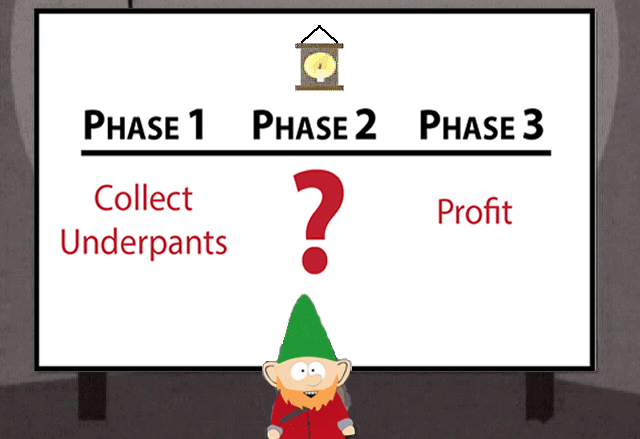
Twenty years ago (yikes!) South Park had an episode that was an indictment of the booming pre-Y2K tech bubble in the stock market. The allegory was gnomes who were stealing underpants with the aim to make a profit. The only problem was the gnomes had no idea how to connect stealing underpants with making money. They had a beginning and an anticipated end, but no middle at all.
underpants-gnomes-business-plan.png

This exact thing is happening with writers who don’t know what story they’re trying to tell. They’re trying to connect the thing that excites them – their hook, character, setting, or theme – with a finished book. They don’t understand the middle part, the actual story, at all, and that’s why they’re getting stuck, or having to rework it, or abandoning it altogether.

So what’s the fix? What do you do when this happens? You’ll have to find what works for you, but when I’m working on a story, I talk it out. I tell the story, just like Homer did 2,800 years ago, out loud, over and over and over. It helps that I live alone. Talking out the story, telling the story, helps me get a handle on it, to understand what I want to say and how I want to say it. Pretty quickly I also get to know what I’m missing. Once I know the story then I can get to the technical parts and start constructing the narrative.

Maybe next week I’ll have details about the developmental editing process? We’ll find out together.

Join the community